How to Read a Casino Scene Through Its Design
Use this casino scene close-reading activity to see how layout, light, and sound shape a story’s portrayal of chance, attention, and control.
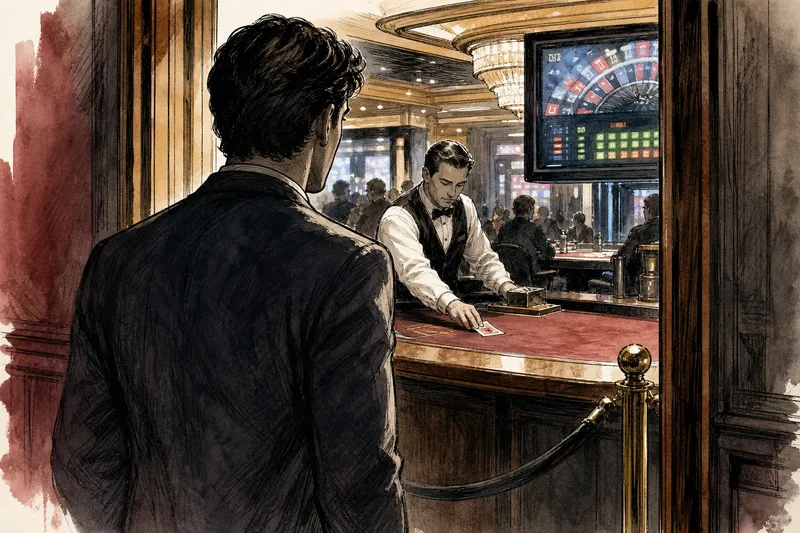
What can a casino scene suggest about chance and control before a character explains either one? This casino scene close-reading activity looks beyond mood to the choices a work makes about space, attention, and representation. A doorway can work like a camera frame: it determines what enters view and what remains outside it.
Start with the frame
Choose a self-contained scene from a story, screenplay, or film, and note who or what the audience can see. In a film, record when the camera shows a broad view and when it isolates a face, hand, sign, or table. In prose, notice whose perspective filters the description and which details receive emphasis.
On the first pass, write down the scene’s visible or described elements without interpreting them. For example: “The camera stays on the dealer’s hands while two players speak.” That statement is different from “the scene makes the dealer seem powerful,” which is an interpretation that needs support from the framing and surrounding action.
Read the room’s design
Ask how the work organizes the casino space. Look for boundaries such as counters, doors, tables, screens, and corridors. Notice who can cross them, who waits, and who appears to control access. These choices can make a setting feel open, divided, welcoming, or restrictive without proving that every real venue works the same way.
Lighting, sound, and surfaces also help establish the scene’s point of view. A bright sign may draw attention away from a conversation; a repeated announcement may compete with a character’s words. Treat each detail as part of the work’s construction, not as evidence about casinos in general.
Notice who gets agency
Agency means the ability to make choices that affect what happens next. Track who initiates an action, who responds, and whose decisions change the scene. A character who sets the rules, handles the cards, or controls the doorway may appear influential, but the scene’s framing can complicate that impression by showing another person’s perspective or limits.
Representation also depends on whose inner life the audience can access. Does the work give a player private thoughts, or show that person only from a distance? Are workers given distinct roles and dialogue, or treated as background? These questions help distinguish a character from the function the scene assigns them.
Trace design and power
- Observation: The camera repeatedly frames a character behind a counter. Decision: If the character controls what passes across it, discuss the counter as a boundary of authority; if the character is simply shown there once, describe the placement without making it a larger claim.
- Observation: A sign or screen appears during a character’s decision. Decision: If the character looks at it or responds to it, connect the display to that choice; if no response follows, treat it as part of the setting rather than a proven influence.
- Observation: One character speaks while another remains silent. Decision: If the silent character’s actions alter what happens, include that agency in your reading; if the scene gives no such action, describe the imbalance in dialogue without guessing at motive.
- Observation: A worker handles objects while customers speak. Decision: If the work affects the scene’s outcome, explain the role the character plays; if the action is only background, avoid claiming the work is central to the plot.
- Observation: A door separates the main room from another space. Decision: If someone crosses it and the scene changes, examine the shift; if nobody crosses, note the boundary and leave its meaning open.
- Observation: The scene cuts from a group to one person’s face. Decision: If that person’s reaction shapes the next event, connect the close framing to the change; if the plot continues unchanged, describe the shift in attention without assigning it a hidden message.
Questions about casino scenes?
How can I tell what a prop means?
First describe where the object appears and what characters do with it. If the work returns to it or connects it to a choice, explain that pattern; if not, leave its symbolic meaning uncertain.
Does a casino scene reflect real venues?
A fictional scene shows how a particular work constructs a casino, not how every real venue operates. Keep claims about customs, workers, and atmosphere tied to what the work actually presents.
How do I separate fact from interpretation?
Write an observable detail first, then state what you infer from it and why. If another reading fits the same detail, acknowledge that possibility rather than presenting your interpretation as the only answer.
Work through a scene
Imagine an invented screenplay scene with these starting details: one visitor, one dealer, a counter, a screen, and a doorway. The visitor pauses at the doorway; the dealer slides a card across the counter; the screen changes; the visitor then sits. The script gives no dialogue or explanation.
List the sequence in that order, then connect each detail to a question. The doorway marks a boundary, but the visitor crosses it. The dealer handles the card, so the dealer performs the visible action; the visitor’s later choice to sit gives the visitor a separate action. The screen changes before the visitor sits, but the script does not say the visitor noticed it. The defensible reading is that the scene gives the dealer control over the card and the visitor control over whether to enter the game; it does not establish that the screen caused the decision. If a later line says the visitor watched the screen, that new detail would support revising the interpretation.
Build a focused reading
Shape the evidence into a claim about how the work represents attention or agency. For instance, you might argue that the scene divides control between the person handling the cards and the person deciding whether to participate. Support that claim with specific actions, and distinguish what the script states from what you infer.
A casino scene close-reading activity is most useful when it keeps the work’s choices in view. Track who controls the frame, who makes consequential decisions, and what remains unexplained; that distinction lets you describe the scene precisely without turning one fictional room into a claim about every casino.