Why Casino Rooms Keep Returning in Novels and Films
Why do casino rooms return in novels and films? See how public space, labor, and social roles shape a story’s conflict without reducing a casino to a symbol.
Why do casino rooms return in novels and films? Casino settings in fiction can bring public rules, paid work, and social status into one shared space, making them useful for stories about who belongs and who gets to decide.
Public space and belonging
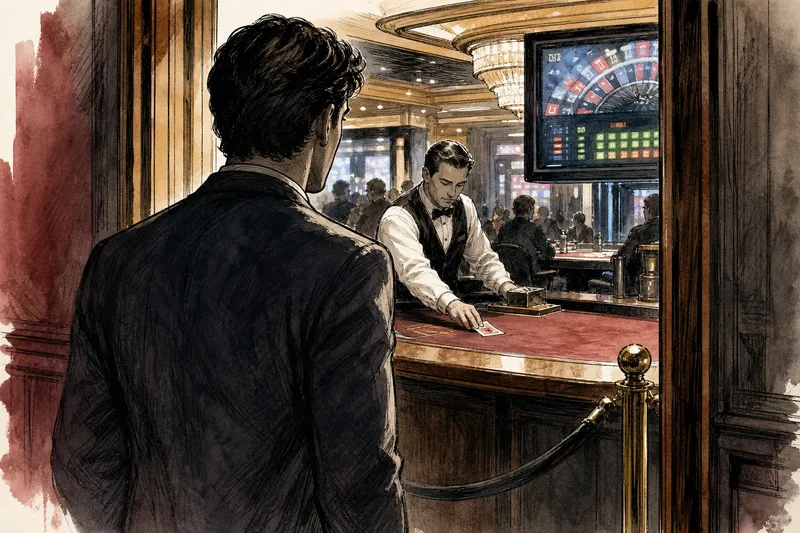
A casino is not simply a backdrop for a private contest. It is a public-facing institution with thresholds, designated roles, and expectations about conduct. A story can use that arrangement to ask who moves freely, who must request permission, and whose presence attracts attention.
Those questions make the room useful for exploring social membership rather than merely building suspense. A character might feel at ease because the space recognizes their status, or feel conspicuous because they do not know its conventions. The narrative can show that difference through access, address, and who is expected to wait.
Labor and visibility
Stories often give visitors the most attention, while the labor that sustains the room stays in the background. Dealers, cleaners, servers, and security staff may appear as people with tasks, or as anonymous parts of the setting. That choice shapes whose experience the audience is invited to notice.
A worker becomes more than scenery when the story gives them a perspective or a decision with consequences. For instance, a cleaner who pauses to warn a visitor about a blocked corridor has knowledge the visitor lacks. The moment can shift attention from spectacle to the work and expertise that keep a public place usable.
Status through language
Dialogue can reveal social position without explaining it directly. A formal request, a familiar greeting, or an order can signal who expects cooperation and who is expected to provide it. The same words may carry different weight depending on the speaker’s role and the listener’s room to refuse.
That does not mean every brief exchange has one fixed meaning. A character’s tone, the response they receive, and what happens next all matter. Careful interpretation stays with those details instead of treating a single gesture as proof of a broad claim about class or power.
What do casino stories reveal?
Why set a story in a casino?
The setting places visitors, workers, and rules in close contact. That gives a writer a way to explore access, work, or status through their relationships.
Can a casino scene matter without gambling?
Yes. A scene about a shift, a meeting, or finding an exit can use the institution’s public roles and expectations without centering a game.
How can dialogue show status?
Notice who gives instructions, who asks permission, and how others respond. Those exchanges suggest a relationship, though the surrounding scene may complicate the first impression.
What makes a worker more than background?
A worker gains narrative presence when the story gives them knowledge, aims, or choices that affect events. A uniform or brief appearance alone does not establish a full point of view.
A meeting at the entrance
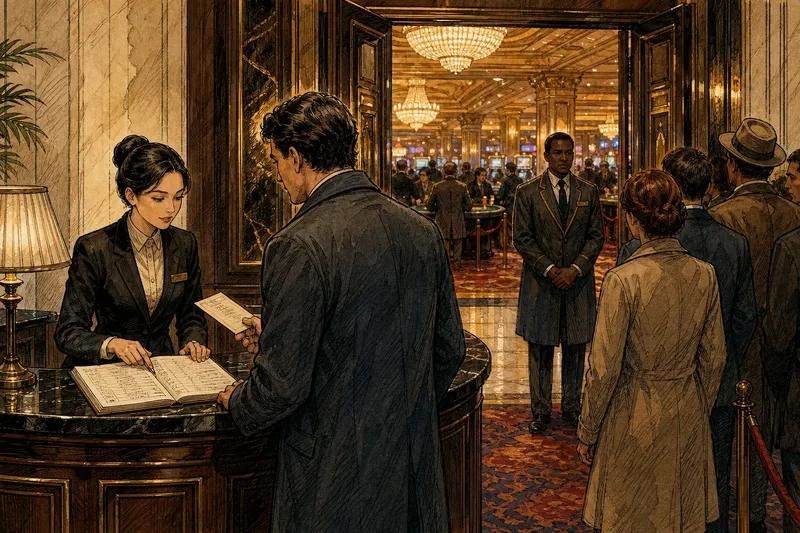
Imagine an invented scene beginning with a visitor carrying a paper invitation and a receptionist facing a crowded entryway. The visitor asks where to meet a companion; the receptionist checks the name against a handwritten list, then points toward a quiet lounge. The visitor follows that direction, while the receptionist returns to greeting people waiting behind them.
The starting quantities are one invitation, one visitor, one receptionist, and one list with a name to check. The visitor presents the invitation; the receptionist checks the name and gives directions. The observable result is that the visitor reaches the lounge while the receptionist continues managing the entrance. The scene can show how a small act of assistance mediates access without claiming that one exchange explains the whole institution.
Meaning beyond spectacle
For stories about casino settings, ask what the institution makes visible: its rules, its workers, its language, or the difference between those who move confidently and those who need help. This focus shifts interpretation away from treating the room as an automatic emblem of wealth or risk.
A useful final question is whose experience the scene leaves out. If workers appear only when visitors need something, that omission may shape the story’s social world as strongly as any dramatic exchange. Notice the boundary between what the scene shows and what it leaves unseen.